
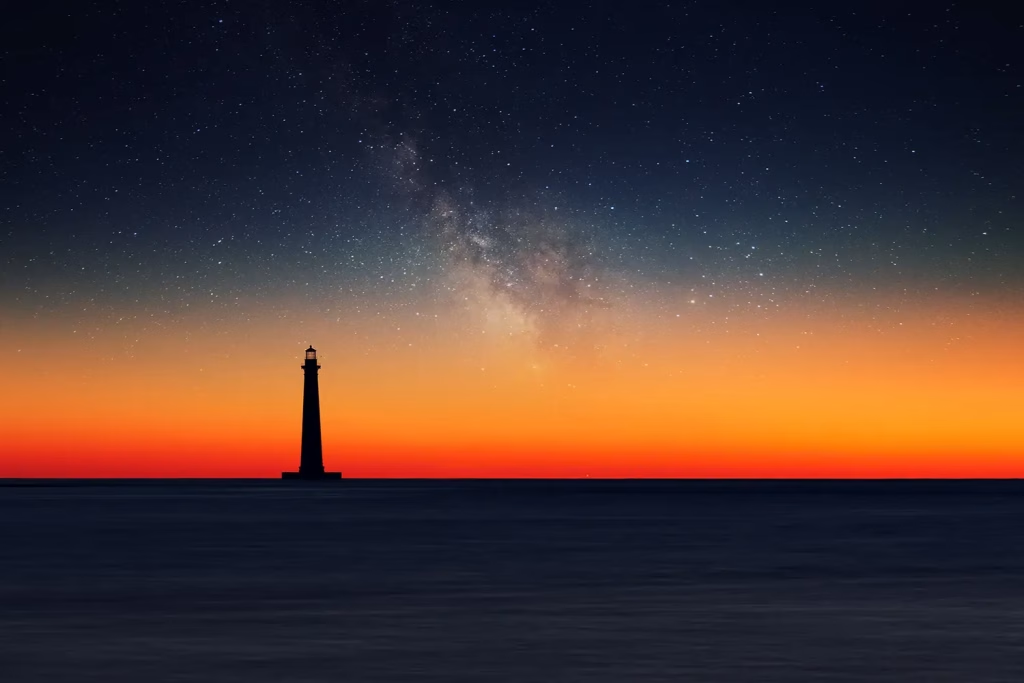
Throughout the history of the Morris Island Lighthouse, it has weathered hurricanes, war, erosion, and neglect. But one of its earliest tests came on a warm summer night in 1886, when the ground itself turned against it. In under a minute, one of the most powerful earthquakes ever recorded in the eastern United States cracked the tower’s masonry walls and knocked its great lens out of place, and the keeper on duty that night lived to describe exactly what it felt like.
A Tower Already Tested
By 1886, the Charleston Main Light standing on Morris Island was still young. It had been completed just a decade earlier, in 1876, after Congress funded a full rebuild of the lighthouse that had stood on Morris Island, destroyed during the Civil War. At 161 feet, the new lighthouse was the tallest in South Carolina, built of brick, mortar, and iron over a timber piling foundation and fitted with a first-order Fresnel lens that could throw its beam far out to sea.
The tower had already taken a hit before the earthquake ever struck. A hurricane in 1885 had already battered the station, and repairs were still fresh when a very different kind of disaster arrived.
“The Earth Began to Tremble and Jerk”
Head Keeper John Wieking left a firsthand account of the 1886 Charleston Earthquake. At 9:53 p.m. on August 31, 1886, he stepped out of the keeper’s house to climb the tower for his watch. His hand was still on the doorknob when he heard a low rumbling and felt the ground tremble, then tear and jerk beneath him.
The shaking lasted less than a minute, but it was followed almost immediately by aftershocks. The first came within ten minutes, and at least seven more were felt within the following 24 hours. For a keeper alone in a brick tower well over a hundred feet tall, it must have been one of the longest minutes of his life.
Cracks in the Tower
When the shaking stopped, the damage was clear. The earthquake had thrown the First Order Fresnel lens out of position and broken off a piece of it. The tower itself had cracked in two places: one crack ran diagonally from the arch above the entrance door up through several courses of brick, and a second, more complicated crack traveled both horizontally and vertically through the interior of the structure.
Engineers who inspected the tower afterward concluded that the cracks did not put its stability at immediate risk, though they discussed how best to reinforce it going forward, either by cutting out and replacing damaged sections of masonry or by running iron rods through the structure for added support. The lens was reset and the worst of the damage addressed quickly enough that the light did not go dark for long.
A City in Ruins
The lighthouse’s damage was minor compared to what the earthquake did to Charleston itself. A U.S. Geological Survey analysis puts its magnitude at approximately 7.0, making it one of the strongest earthquakes ever recorded east of the Rocky Mountains. Nearly all of the roughly 8,000 buildings in the city sustained some kind of damage, from broken windows to major structural cracking, with brick buildings hit hardest.
Sources differ on the exact human toll, a common problem with disasters from this period, when record-keeping was inconsistent and often undercounted residents. Estimates range from around 60 confirmed deaths, the figure most often cited by seismologists, to over 100 in some contemporary and later accounts. Damage across the region was estimated at $5 to $6 million in 1886 dollars, and a U.S. Geological Survey study conducted in 1978 placed total economic losses at roughly $23 million in that era’s dollars, illustrating just how costly the disaster remained even decades later. The tremors were felt as far away as Boston, Chicago, and Cuba.
Standing Firm
Despite the cracks in its walls, the Morris Island Lighthouse kept its light burning. It went on to guide ships along the Charleston coast for another 76 years after the earthquake, through more storms, through the slow encroachment of erosion that eventually left it standing offshore, and through the shift to automated operation in 1938. It was finally retired from active service in 1962, replaced by a newer light on Sullivan’s Island.
The 1886 earthquake is easy to overlook next to the lighthouse’s more visible battles today, especially the erosion that now threatens its very foundation. But it is one of the earliest proofs of just how much this tower can withstand. The keepers who worked here weathered a night most Charlestonians never forgot, and the structure they maintained came through it standing.
Help Us Keep the Light Standing
The Morris Island Lighthouse has survived a Civil War, a hurricane, an earthquake, and more than a century of erosion. It’s still standing today because people chose to fight for it. Save the Light continues that work, and we would love for you to be part of it.
- Attend our 150th Birthday Celebration for the Morris Island Lighthouse on October 18th, 2026.
- Become a member, starting at just $25 a year.
- Make a donation online, by phone, or by mail — every dollar goes directly to preservation.
- Pick up a bag of the Lighthouse Roast at Bert’s on Folly or through the online shop. Twenty percent of every bag goes straight to preservation.
- Order a Save the Light hat, t-shirt, quarter-zip, tote bag, or note card set from our online shop to support our mission.