
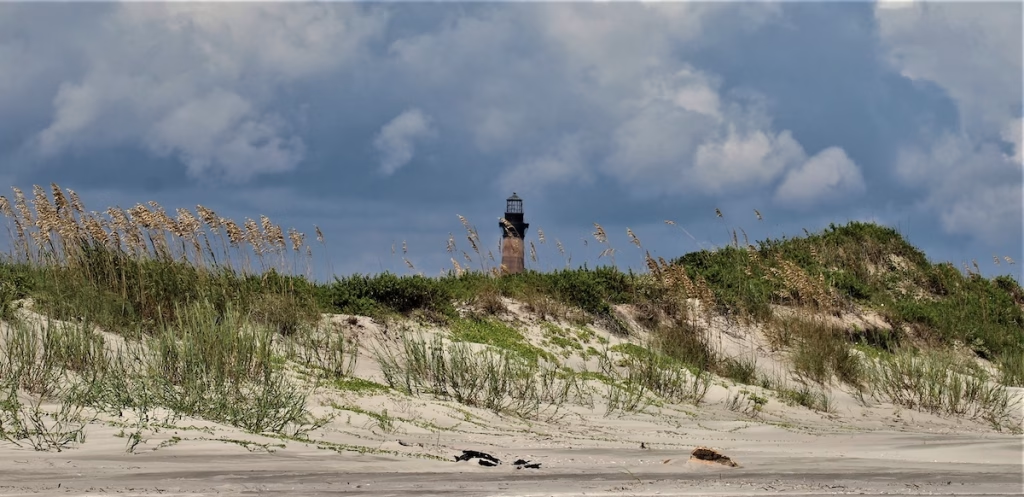
If you’ve ever watched a storm roll in off the Atlantic and thought about everything along this coastline that has weathered far worse, the Morris Island Lighthouse probably came to mind. Rising 161 feet above the water just off Folly Beach, it or one of its predecessors has stood at the entrance to Charleston Harbor through revolutions, wars, and an earthquake that rattled the whole Eastern Seaboard. But perhaps nothing has tested it quite like the storms.
Over nearly 260 years, hurricanes have battered these lighthouses, stripped them of their surrounding buildings one by one, and accelerated the many factors that now threaten the current lighthouse’s existence. And through all of it, the tower itself has never fallen due to storms.
Here is the history of what the storms did — and why the lighthouse is still standing.
The Great Carolina Hurricane of 1854: The First Major Test
The current lighthouse tower wasn’t even standing yet when storms began leaving their mark on Morris Island. Today’s lighthouse is actually the third version — the second, a 102-foot brick tower built circa 1786 and repaired in 1801, faced what historians now call the Great Carolina Hurricane in September of 1854.
By modern classification, it was a Category 3 storm, making landfall just south of Savannah and sending a 16-foot storm surge crashing into the South Carolina coast. Morris Island suffered the brunt of heavy winds and storm surges. The lighthouse sustained severe damage, and the lightkeeper’s dwelling, the five beacons, bridges, and docks on the island were all destroyed.
Congress eventually stepped in, funding repairs and the installation of a brand-new first-order Fresnel lens in 1858. The lighthouse survived, but the storm left a mark on the island and its infrastructure that would never fully heal.
The Cyclone of 1885: A Near-Total Wipeout on the Grounds
By 1876, the third and current lighthouse had been built — the 161-foot brick tower with its distinctive horizontal bands that locals and visitors know today. The lighthouse complex at that point was a real settlement: three keepers’ residences, a schoolhouse for their children, outbuildings, barns, chicken coops, and a network of walkways and docks connecting the island’s structures. It was, by all accounts, a functioning little community.
The cyclone of August 25, 1885, destroyed the rear beacon of the Morris Island range, overturned part of the brick wall enclosing the tower and dwelling, carried away the bridge between the beacons, destroyed a large part of the plank walks connecting the lights and dwellings, and overturned the boathouse. The lighthouse tower itself held, but nearly everything around it was gone.
The cyclone struck just a year before the 1886 Charleston earthquake, one of the most powerful seismic events ever to hit the East Coast, which threw the lighthouse’s main lens out of position and cracked the tower in two places. Workers repaired both without delay, and the lighthouse kept operating. But the back-to-back disasters of 1885 and 1886 signaled that Morris Island was a vulnerable place — and the worst was still coming.
Hurricane Hugo, 1989: The Night That Changed Everything
For those of us who live along the Lowcountry coast, there is a before and after Hugo. The historical storm made landfall just north of Charleston near Sullivan’s Island around midnight on September 22, 1989, as a Category 4 hurricane with sustained winds of 135 miles per hour. The storm tide reached 20 feet at Bulls Bay — the highest ever recorded on the East Coast at the time. Twelve people died on the Isle of Palms and Sullivan’s Island alone.
Hugo could not take the tower itself.
Charleston artist Jim Booth captured that truth in a painting of the Morris Island Lighthouse he had at the printers the very night Hugo made landfall. He had decided in advance that if the lighthouse was still standing after the storm, the painting would be titled Still Standing. It was. And it is. You can see the painting here — a piece that carries as much meaning today as it did the morning after Hugo.
Hurricane Irma, 2017: The Dock Falls
It survived Matthew in 2016. It did not survive Irma.
In September 2017, Hurricane Irma passed well south of Charleston but still delivered one of the highest storm surges the harbor had seen since Hugo — nearly ten feet above normal water levels. The dock, already weathered from decades of exposure, could not hold. Save the Light later had it repaired by 2019, but Irma’s impact served as a sobering reminder of how relentless the forces against this lighthouse truly are.
What the Storms Left Behind
Today, the Morris Island Lighthouse stands more than 2,000 feet offshore, surrounded by open water. Centuries of storms accelerated an erosion process that has claimed the island itself — and in doing so, exposed the lighthouse’s timber pile foundation to the sea, where shipworms infested the structural base, and the threat of collapse was real.
The lighthouse has survived every storm the Atlantic could throw at it. What it cannot survive, without help, is time and neglect.
The Fight to Keep It Standing
Save the Light, Inc. has been fighting for this lighthouse since 1998. A group of concerned Lowcountry residents incorporated as a nonprofit with one goal: to preserve the Morris Island Lighthouse for future generations. The organization purchased the lighthouse in 1999, donated it to the State of South Carolina and its citizens in 2000, and holds a 99-year lease on the structure. Save theLight coordinates with both the State Historic Preservation Office, and the U.S. Army Corps of Engineers, and raises the funds needed to make stabilization and restoration possible.
Phase 1 of the preservation plan — a cofferdam surrounding the lighthouse base — was completed in 2008. Phase 2 – 68 cementitious grout pilings bored beneath the lighthouse base – was completed in 2010. But the work is far from finished, and funding remains the critical challenge. Many of the lighthouse’s iron and masonry components are currently rated critical, with preservation efforts only about 20% funded.
There are several ways to get involved and make a real difference:
- Make a donation online, by phone, or by mail — every dollar goes directly to preservation.
- Become a member, starting at just $25 a year.
- Participate in an event. From the upcoming 150th Celebration of the first lighting, to the Annual Oyster Roast at Bowen’s Island, to the Save the Light Half Marathon & 5K on Folly Beach, there are fun ways to support the cause and enjoy the Lowcountry while you’re at it.
The Morris Island Lighthouse has survived the Great Carolina Hurricane, the Cyclone of 1885, Hurricane Hugo, and Hurricane Irma and many more lesser cyclones. It has outlasted the Confederacy, private neglect, and 260 years of Atlantic weather. What it needs now is us — the people who love this coast and this history — to make sure it’s still standing for the next 260 years.